Source Portable Self Heating Espresso Coffee Maker for Travel
Find and compare 30 portable self heating espresso coffee maker options for home, office, and travel use. Review specifications including battery capacity, pump pressure, and material to select the right unit for your sourcing needs.
Key considerations
Products List


Comprehensive Sourcing Guide
Portable Self Heating Espresso Coffee Maker Sourcing Guide
Sourcing portable espresso solutions requires a nuanced understanding of the divergence between traditional mains-powered machines and battery-operated units designed for mobility. The market currently presents two distinct categories: manual pump devices that rely on user effort to generate pressure, and automated units that integrate heating elements with rechargeable batteries. Buyers must first determine whether their end-users prioritize the authentic crema and pressure of a heated extraction or the convenience of a compact, battery-powered system that may sacrifice thermal consistency for portability. This distinction dictates the entire supply chain strategy, from component sourcing to final assembly verification.
The observed product landscape reveals a significant split in technology. Some listings describe "full-automatic" procedures with heating functions, while others specify "manual" operation with steam or pump pressure principles. Furthermore, power sources vary from high-capacity lithium batteries (e.g., 7800mAh) to USB-rechargeable systems with lower wattage outputs. Procurement teams must align their technical requirements with these observed variations, ensuring that the selected model meets the specific energy and pressure demands of the target application, whether it be camping, office use, or travel.
Product Scope and Observed Listing Signals
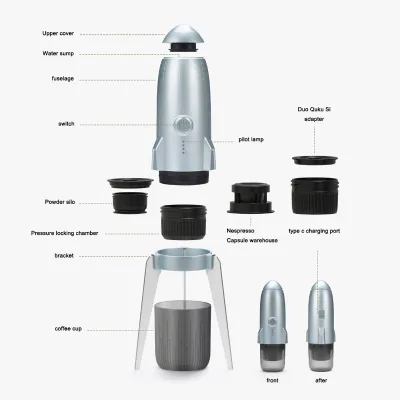
The current market signals indicate a wide range of capabilities, from basic capsule-compatible brewers to complex powder-processing units. Listings show models capable of handling both coffee powder and pre-packaged capsules, suggesting a flexible design approach by manufacturers. The observed capacity ranges from less than five cups to ten cups, which directly impacts the physical footprint and battery size required. Buyers should note that "portable" does not always imply "lightweight"; some units with larger water tanks and heating elements may be heavier, affecting their suitability for backpacking or frequent travel.
Color and material specifications also vary, with stainless steel housing and black or white finishes being common. The presence of "Italian style" aesthetics suggests a focus on design appeal, which is a key differentiator in the consumer market. However, buyers must verify if the "Italian style" refers to the brewing method or merely the visual design. Additionally, the inclusion of features like logo printing indicates that these products are frequently sourced for private labeling, making customization capabilities a critical factor in supplier selection.
Technical Specifications to Verify
Voltage and power requirements are the most critical technical differentiators for portable devices. Observed data shows a mix of 12V working voltages and 5V/2A charging inputs, with power outputs ranging from 72W to unspecified levels for manual units. Buyers must verify the actual heating power versus the battery capacity to ensure sufficient brew temperature. For instance, a unit with a 7800mAh battery may struggle to maintain consistent heat for multiple shots if the heating element draws excessive current. It is essential to request detailed electrical schematics to understand the power management system.
Pressure generation methods also require strict verification. While some listings claim 20 bars of pump pressure, others rely on manual steam or lever pressure. For true espresso, 9 bars is typically sufficient, but higher pressures are often marketed for crema enhancement. Buyers should test the actual pressure output under load, as marketing claims may not reflect real-world performance. Additionally, the water tank capacity, observed at 60ml for some models, limits the number of shots per fill. This constraint must be evaluated against the intended usage scenario to avoid customer dissatisfaction.
Compliance and Safety Documentation
Certification requirements vary by region and product type. Observed listings include CE, RoHS, and LFGB certifications, indicating compliance with European safety and material standards. However, buyers must confirm that these certifications apply to the specific model being ordered, as manufacturers may hold certifications for one variant but not another. For battery-powered devices, UN38.3 testing and MSDS documentation are mandatory for shipping, especially via air freight. Buyers should request valid certificates for each SKU to ensure smooth customs clearance.
Material safety is another critical area, particularly for devices that heat water. The use of stainless steel housing is common, but the internal water path materials must be food-grade. LFGB certification specifically addresses German food safety standards, which are stricter than general CE requirements. Buyers should verify that all components coming into contact with water or coffee are certified for food contact. Additionally, electrical safety standards for rechargeable batteries must be checked to prevent overheating or leakage risks during use.
Cost Drivers and Commercial Terms
Pricing in this category is influenced by the complexity of the heating and battery systems. Observed price ranges span from $0.86 to $120, reflecting a vast difference between simple manual pumps and complex automatic units. The lower end of the spectrum likely represents manual devices with minimal electronics, while the higher end includes units with microprocessors, precise temperature control, and high-capacity batteries. Buyers should analyze the cost breakdown to understand the value proposition, ensuring that they are not overpaying for features that are not required for their target market.
Minimum Order Quantities (MOQ) also vary significantly, with observed values ranging from 1 set to 1000 units. This flexibility allows for both small-scale testing and large-volume production. However, buyers should be aware that lower MOQs may come with higher per-unit costs. Customization options, such as logo printing and packaging, may incur additional setup fees. It is advisable to negotiate tiered pricing structures that reward larger orders while maintaining flexibility for initial batches.
Supplier Qualification and Quality Control
Supplier verification should focus on their ability to manage both mechanical and electronic components. Since portable espresso makers combine plumbing, heating elements, and battery management systems, suppliers must have expertise in multiple disciplines. Buyers should request evidence of assembly line capabilities and quality control processes for both mechanical integrity and electrical safety. Factories that specialize in only one aspect may struggle with the integration of these diverse systems.
Quality control checks should include pressure testing, leak detection, and battery cycle testing. Buyers should define acceptance criteria for these tests before production begins. Additionally, since many suppliers offer customization, buyers must verify that the customization process does not compromise the structural integrity or electrical safety of the device. Regular audits and sample testing are essential to maintain consistency across production batches.
Long-Term Procurement Checks
After-sales support and spare parts availability are crucial for portable devices, which are subject to wear and tear. Buyers should inquire about the availability of replacement parts such as seals, batteries, and heating elements. A robust supply chain for spare parts can extend the product lifecycle and enhance customer satisfaction. Suppliers who offer comprehensive warranty terms and technical support are preferable for long-term partnerships.
Market trends in portable coffee equipment are shifting towards higher efficiency and smarter features. Buyers should stay informed about advancements in battery technology and brewing precision. Regularly reviewing supplier capabilities and product innovations will help maintain a competitive edge. Engaging with suppliers for continuous improvement and feedback can lead to better product designs and more reliable supply chains.
FAQs
What certifications do these coffee makers have?
The products hold CE, RoHS, and LFGB certifications. These standards ensure safety and compliance for both commercial and home use applications across different regions.
Can I customize the logo on the machine?
Yes, customization is available for the logo via printing. Buyers can request specific branding on the black or white housing materials to match their business identity.
How much coffee can the water tank hold?
The water tank capacity is 60ml, suitable for single servings. This compact size supports the 150ml coffee cup output for portable or travel scenarios.
What is the minimum order quantity for these units?
The minimum order quantity ranges from 1 set to 12 units depending on the specific model. Some listings allow a single unit purchase while others require higher volumes.
Which working principle powers the espresso extraction?
The machines utilize pump pressure or steam working principles. This ensures proper extraction for coffee powder or capsule materials in both automatic and manual procedures.
What is the battery capacity for portable operation?
The device features a built-in 7800mAh battery for portable use. It supports 12V working voltage and charges via USB with 5V/2A input for convenience.